I stopped watching THE GOOD WIFE a couple seasons ago, to be truthful. It was really because I saw the looming love affair between Alicia and Will becoming "real," and I just did not want to deal with the coming duplicity, conflict and all-too-familiar baggage that goes with a love triangle in such a series, where there is a lot of smoke, some heat and no real fire... or change.
That said, from the very beginning I loved the commitment of the producers to this show--centered around a smart, hard-working woman--and the fashion style that went along.
Of course, it must be horribly unpleasant to have the weekly task of dressing Julianna Margulies, Christine Baranski and Archie Punjabi, three of the most unattractive and style-deprived women in modern America. I pity the costumers, wardrobe personnel and dressers... not.
One of the reasons I admire the style here is that, for once, the stylists and costume designers get it right for professional women. Baranski's Diane Lockhart is a woman who is intelligent, wealthy and stylish, able to use her personal style as a tool in her arsenal as a high-end lawyer, the senior partner leading a small but very successful firm. Margulies's character has moved a long distance in four seasons: she started as the SAHM who returns to the legal profession (as a litigator/associate) when her husband, a state's attorney, goes to jail, but in season 4 she becomes a partner in Baranski's firm. Punjabi plays Kalinda Sharma, an investigator who works solely for that same firm; she and Margulies are friends, but Sharma's character is not a lawyer.
Although all three women are attractive, there is no emphasis on sexy female bodies, no cleavage, no embarassingly tight skirts in court, no childish junior-girl fashion. Instead, all three women convincingly play "professionals."
I've always liked Margulies, ever since E.R., but here she is actually carrying the show (with superb support throughout). Her style is suits and separates, mostly skirts--with polish and class. The colors run from black and gray to wine, scarlet, royal blue and beige-y tones. Her accessories are nice but modest (almost no jewelry, for example), her hair is simply done, and her make-up adult.
Baranski of course has a dancer's body, a long and lean but curvy silhouette. Her character wears suits, too, obviously high-end designers, very luxe. Her accessories as "da bomb," ranging from pearls and Hermes bags to real stones set in gold and statement pieces. The best thing about Baranski is that she wears the clothes and accessories, not the other way around. Her hair, too, is simple and her make-up excellent. The colors run from charcoal to purples and blues, to beiges and creams.
Punjabi is shorter than the other two, probably petite. She wears leather--a lot of leather jackets, wide leather belts and a kick-ass pair of leather boots--contrasted with soft knits and wools, jeans, and very few accessories. Her clothes are edgier, sexier, tighter--but she still looks professional. Like a private eye, not a pole dancer. Her colors are darker, too.
The men in the show are equally well-tailored, wearing suits, ties and shirts. But it is the women who provide the real class and style for this show.
The great part is that this style is not out of reach, even when it is clear that the costumers aim at haute couture business wear. It is more about fabric, color and texture, plus the careful accessorizing, skirt lengths, excellent tailoring/fit and (frankly) superb support garments, hose and underwear.
On the red carpet, of course, they are all three enviably gorgeous.
My favorite character, of course, is Eli Gold, as played by Alan Cumming.
Showing posts with label fashion. Show all posts
Wednesday, May 1, 2013
Monday, April 29, 2013
Thrifting Weekend
On Friday and Saturday I went thrifting, looking for some items to fill in gaps in my spring/summer wardrobe, especially for London.
Friday: I went to Buffalo Exchange and used one of the two credit cards I'd acquired by selling excess clothing. I bought a denim jacket ($8) and black&white polka dot dress ($15), each of which fits perfectly. The demin jacket was one piece I was determined to find, and the cost was $0 because I used the card.
Saturday: I went out to a strip with several thrifts where I had never been. At the first one, I bought two coats, a blue 3/4 jacket in a particularly lovely shade ($4.98) and a silver tissue coat that is nothing like my usual fare ($6.98).
At the second shop, I bought a small gold-framed mirror to hand by the front door ($7) and a basket the perfect size for the monthly magazines/catalogs ($5).
At the third, I found a paisley cardigan ($7), a black&white tweed linen jacket ($6.50) and a Willi Smith skirt ($8).
The good news is that each piece will not only go well with most of the others, but will mix into the basic black/white/blue/rust scheme of my summer clothes.
Friday: I went to Buffalo Exchange and used one of the two credit cards I'd acquired by selling excess clothing. I bought a denim jacket ($8) and black&white polka dot dress ($15), each of which fits perfectly. The demin jacket was one piece I was determined to find, and the cost was $0 because I used the card.
![]() |
| Denim Jacket similar to this one |
![]() |
| Polka Dot Dress just like this one |
Saturday: I went out to a strip with several thrifts where I had never been. At the first one, I bought two coats, a blue 3/4 jacket in a particularly lovely shade ($4.98) and a silver tissue coat that is nothing like my usual fare ($6.98).
![]() |
| Blue Jacket similar to this one, in this exact color |
![]() |
| Silver Coat similar, but softer in its lines |
At the second shop, I bought a small gold-framed mirror to hand by the front door ($7) and a basket the perfect size for the monthly magazines/catalogs ($5).
At the third, I found a paisley cardigan ($7), a black&white tweed linen jacket ($6.50) and a Willi Smith skirt ($8).
![]() |
| Similar, but waist-length and without buttons |
![]() |
| Tissue-weight linen, with center closure |
![]() |
| Full skirt, black with fuschia and white floral pattern |
The good news is that each piece will not only go well with most of the others, but will mix into the basic black/white/blue/rust scheme of my summer clothes.
Wednesday, March 27, 2013
What is the Value/Cost of a T-shirt?
Funny, true story: this past Sunday, I was relaxing at home when the plumber showed up.
I knew he was coming, and I had already been out, to breakfast and the grocery store, but when I arrived home after errands I changed into a worn t-shirt and flannel pj pants and socks to clean house, put away groceries, read the paper, and watch TV.
And by "worn," I mean shapeless and day-old, plus no support underneath. And by "flannel pj pants," I mean... you get it, same day-old.
The plumber showed up fifteen minutes early and caught me in that get-up... and I couldn't change out.
Then, I had to go out into the apartment courtyard to tell my neighbors on either side that the water was turned off--in pj flannels, sloppy old tshirt, and slippers--and chat with a third neighbor who wondered what was going on. Oh, and go back over to the neighbors once the water was turned back on. And I was embarrassed my neighbors saw me like that.
Do you see where I'm going with this?
Mostly, we think no one will notice. I think, I'll just run into the grocery store, grab the cheese and head back to the car. No one (I know) will see me.
The truth is lots of people see us, but more importantly we project how we feel about ourselves right out into public. It's okay if strangers see us like this... it's okay if people who know/like us see us like this... it's okay if we feel this way about ourselves. People will still like us/find us attractive/look beyond the surface because beauty is more than skin deep.
Part of my response to myself was simply a kind of slap upside the head: I knew he was coming and I knew I'd be embarrassed if anyone saw me in that sloppy outfit... but I put off changing. And I got caught. (Lazy.)
Part of my response to myself was to assess--for real--how embarrassed I was and how sloppy my at-home attire had become. I do tend to slip out of work gear to what I call "soft clothes," yoga pants or sweat pants, a t-shirt or chambray shirt, and barefeet with slippers at the ready. But, lately, it's been all about the flannel pjs and really worn t-shirt, more of a "nap/sleep" gear than a comfy "do work around the house" gear. And, after all, no one will see (judge) me.
Except myself.
While I don't want to wear formal clothes at home, I need to discard the shapeless, frayed, stained, torn and lifeless sweats, flannels, and t-shirts that have become a comfy staple. Why? Because they feel sloppy. They look sloppy. They project an attitude of carelessness and laziness I realize I take on when I wear them (see above). I have plenty of well-fitting, clean, attractive t-shirts: I am not against t-shirts as a category. I have good yoga pants and sweatpants: I can discard the pj bottoms that are five years old and feel so comfortable I do nothing in them but sleep or lounge or nap or procrastinate.
This is where clothes can affect my attitude about myself and how I spend my time. When I want to focus, I don't really want to find myself in a tatty, stretched-out t-shirt and pants duo, because I want to get to work. Being "too comfy" is different from being casual. I don't want to feel as if I project a "giving up" about my age, shape, attractiveness--which is exactly what I think those kind of clothes say. If I wouldn't wear them in front of people, why wear them for myself?
I feel another Goodwill bundle coming on. Or more cleaning rags.
I knew he was coming, and I had already been out, to breakfast and the grocery store, but when I arrived home after errands I changed into a worn t-shirt and flannel pj pants and socks to clean house, put away groceries, read the paper, and watch TV.
And by "worn," I mean shapeless and day-old, plus no support underneath. And by "flannel pj pants," I mean... you get it, same day-old.
The plumber showed up fifteen minutes early and caught me in that get-up... and I couldn't change out.
Then, I had to go out into the apartment courtyard to tell my neighbors on either side that the water was turned off--in pj flannels, sloppy old tshirt, and slippers--and chat with a third neighbor who wondered what was going on. Oh, and go back over to the neighbors once the water was turned back on. And I was embarrassed my neighbors saw me like that.
![]() |
| Much like this... |
Mostly, we think no one will notice. I think, I'll just run into the grocery store, grab the cheese and head back to the car. No one (I know) will see me.
The truth is lots of people see us, but more importantly we project how we feel about ourselves right out into public. It's okay if strangers see us like this... it's okay if people who know/like us see us like this... it's okay if we feel this way about ourselves. People will still like us/find us attractive/look beyond the surface because beauty is more than skin deep.
Part of my response to myself was simply a kind of slap upside the head: I knew he was coming and I knew I'd be embarrassed if anyone saw me in that sloppy outfit... but I put off changing. And I got caught. (Lazy.)
Except myself.
While I don't want to wear formal clothes at home, I need to discard the shapeless, frayed, stained, torn and lifeless sweats, flannels, and t-shirts that have become a comfy staple. Why? Because they feel sloppy. They look sloppy. They project an attitude of carelessness and laziness I realize I take on when I wear them (see above). I have plenty of well-fitting, clean, attractive t-shirts: I am not against t-shirts as a category. I have good yoga pants and sweatpants: I can discard the pj bottoms that are five years old and feel so comfortable I do nothing in them but sleep or lounge or nap or procrastinate.
This is where clothes can affect my attitude about myself and how I spend my time. When I want to focus, I don't really want to find myself in a tatty, stretched-out t-shirt and pants duo, because I want to get to work. Being "too comfy" is different from being casual. I don't want to feel as if I project a "giving up" about my age, shape, attractiveness--which is exactly what I think those kind of clothes say. If I wouldn't wear them in front of people, why wear them for myself?
Saturday, March 23, 2013
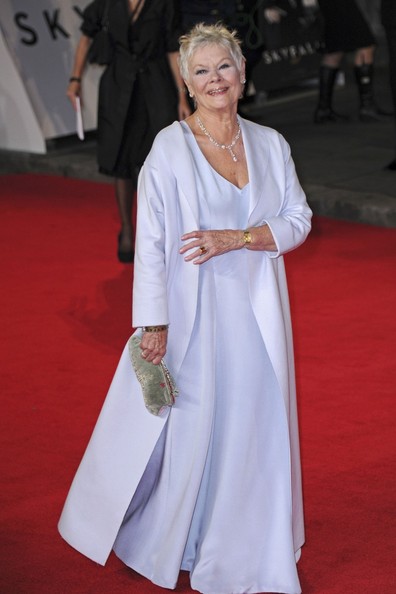
Dench... Dame Judi Dench
Some days I picture Judi and myself sitting in an English garden full of roses, snapdragons and heather, drinking tea and chatting about girlfriend things. BFFs.
I ask her about Daniel and Pierce, she asks me about Jean-Baptiste and Louis, and we laugh and roll our eyes about the various men in our lives.
At five pm, we change to G&Ts. With slices of fresh lime. And a nice curry.
One of the reasons I think this could happen is because Dench has always been a smart, stylish woman who laughs a lot and thinks a lot. She chose a flattering and sophisticated hairstyle early on. As she aged and her body shape changed, she adopted a distinctive and elegant clothing style.
I love her in the role of M. Her style as the head of MI-5, as a woman in charge of her own world and in competition with belligerent and bellicose men (mostly politicians and military leaders), she is distinctive. A role model. A sexy Madeleine Albright with cleavage and the royal glare of Elizabeth I.
And, BTW, I do think she and James had a fling a while back. You could go with the Brosnan-Bond or the Craig-Bond, no matter: it happened.
Oh, yessssss.
Judi's style: She focuses on her eyes, which are remarkable, and adopted a striking hairstyle long ago. Kept it, through brunette to graying salt-and-pepper to white. Her sea-green eyes are indeed remarkable and she uses make-up to focus on those and her cheekbones (smile!).
In clothing, she is a winter-based palette, and -- again, early on, adopted a consistent use of white blouses with open collars, solid color dress-and-coat ensembles or jacket-and skirt ensembles (not suits), and dark, textured fabrics. Black, grays, and browns (see above). Whites and pale turquoises. Fantastic jewelry that includes chokers, collars and closely-fitting necklaces as well as small, well-shaped earrings. In real metals and diamonds.
She also focuses attention on her cleavage and throat, despite having the same aging of her skin in that area that most women have. Judi apparently doesn't care.
What she hides: her ankles, her waist, her height.
I ask her about Daniel and Pierce, she asks me about Jean-Baptiste and Louis, and we laugh and roll our eyes about the various men in our lives.
One of the reasons I think this could happen is because Dench has always been a smart, stylish woman who laughs a lot and thinks a lot. She chose a flattering and sophisticated hairstyle early on. As she aged and her body shape changed, she adopted a distinctive and elegant clothing style.
I love her in the role of M. Her style as the head of MI-5, as a woman in charge of her own world and in competition with belligerent and bellicose men (mostly politicians and military leaders), she is distinctive. A role model. A sexy Madeleine Albright with cleavage and the royal glare of Elizabeth I.
And, BTW, I do think she and James had a fling a while back. You could go with the Brosnan-Bond or the Craig-Bond, no matter: it happened.
Oh, yessssss.
Judi's style: She focuses on her eyes, which are remarkable, and adopted a striking hairstyle long ago. Kept it, through brunette to graying salt-and-pepper to white. Her sea-green eyes are indeed remarkable and she uses make-up to focus on those and her cheekbones (smile!).
In clothing, she is a winter-based palette, and -- again, early on, adopted a consistent use of white blouses with open collars, solid color dress-and-coat ensembles or jacket-and skirt ensembles (not suits), and dark, textured fabrics. Black, grays, and browns (see above). Whites and pale turquoises. Fantastic jewelry that includes chokers, collars and closely-fitting necklaces as well as small, well-shaped earrings. In real metals and diamonds.
She also focuses attention on her cleavage and throat, despite having the same aging of her skin in that area that most women have. Judi apparently doesn't care.
What she hides: her ankles, her waist, her height.
Wednesday, March 20, 2013
Watson and her style
I have been watching Elementary this week. I bought the first season on iTunes and okay, I am obsessed with it.
Which actually surprises me.
I am a HUGE Sherlock Holmes fan: Conan Doyle's stories and novels and the Basil Rathbone films... all great memories. I dislike the Robert Downey Jr. films, but obsess over the Benedict Cumberbatch/Martin Freeman BBC series.
Yeah.
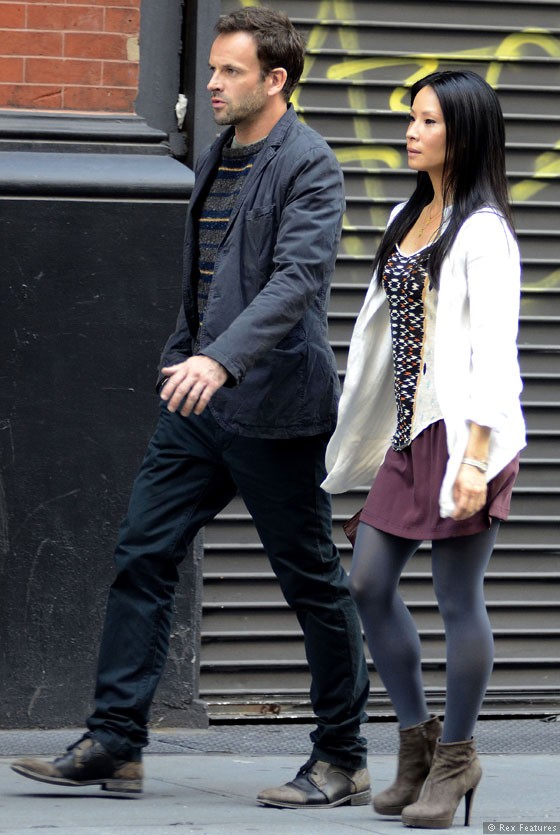
I didn't think I'd like the Jonny Lee Miller/Lucy Liu series, given my suspicion of network TV. But this is fresh, well-written, and well-acted. And I do love Liu as Watson: it's a great twist to have her staged as Holmes' sober companion. Her knowledge parallels his and even adds to it.
I also love her style. She is a character who is an ex-surgeon, someone who lives in with her addict charges, who lives (as she says) as a kind of nomad while her own aparment is let out and her belongings are in storage.
Watson has a kind of sophisticated street style, one that suits the show's relocation to New York and the shooting schedule in wintertime. It looks simple, in fact, but clean and urban, and I love it.
Basic elements:
Basic colors:
Here are some bloggers who also talk about Watson's style:
Of course, Holmes as the centerpiece has usually been the "fashion" focus of illustrators, movie and theatre costumers and actors. In the BBC series, Watson as played by Freeman is a bland kind of guy, wearing fairly boring jumpers and anoraks compared to Holmes' curls and scarves. In the CBS series, however, Holmes is a bit clothing-retarded, wearing the fashion stylings of chess club/AV nerds of stereotypes... which is impressive considering Miller's marathon-ready, tattooed physique.
But it is Liu's casual yet eye-catching gear that lends style to the show.
Which actually surprises me.
I am a HUGE Sherlock Holmes fan: Conan Doyle's stories and novels and the Basil Rathbone films... all great memories. I dislike the Robert Downey Jr. films, but obsess over the Benedict Cumberbatch/Martin Freeman BBC series.
Yeah.
I didn't think I'd like the Jonny Lee Miller/Lucy Liu series, given my suspicion of network TV. But this is fresh, well-written, and well-acted. And I do love Liu as Watson: it's a great twist to have her staged as Holmes' sober companion. Her knowledge parallels his and even adds to it.
I also love her style. She is a character who is an ex-surgeon, someone who lives in with her addict charges, who lives (as she says) as a kind of nomad while her own aparment is let out and her belongings are in storage.
Watson has a kind of sophisticated street style, one that suits the show's relocation to New York and the shooting schedule in wintertime. It looks simple, in fact, but clean and urban, and I love it.
Basic elements:
- t-shirts or tunic blouses in tissue-weight material
- narrow dark pants or tights
- short, flirty skirts
- coats of hip- or knee-length in wrap styles
- hats and scarves
- high-heeled boots, ankle-height or, occasionally, knee-height
- cross-over purses or briefcase
- layers, layers, layers
- solids, stripes and plaids; rarely geometrical patterns
Basic colors:
- BLAAAAAACK
- clean, pure white
- wine, military blue, pale violet, gray (all shades), and bitter-rind orange
Here are some bloggers who also talk about Watson's style:
- http://brainybeautytalk.com/2012/10/02/the-clothing-in-elementary-my-dear-watson-i-love-your-outfit/
- http://popstyle.ew.com/2013/02/07/elementary/
- http://katyaedeleva.blogspot.com/2013/02/stylish-tv-elementary-drwatson-style.html
- http://www.thebrunetteone.com/2012/10/steal-her-style-joan-watson-elementary.html
- http://hellotailor.blogspot.com/2012/09/from-arthur-conan-doyle-to-new-york.html
Of course, Holmes as the centerpiece has usually been the "fashion" focus of illustrators, movie and theatre costumers and actors. In the BBC series, Watson as played by Freeman is a bland kind of guy, wearing fairly boring jumpers and anoraks compared to Holmes' curls and scarves. In the CBS series, however, Holmes is a bit clothing-retarded, wearing the fashion stylings of chess club/AV nerds of stereotypes... which is impressive considering Miller's marathon-ready, tattooed physique.
But it is Liu's casual yet eye-catching gear that lends style to the show.
Thursday, March 14, 2013
The count today, so far...
Into the giveaway bin:
- 3 silk scarves
- 2 wrap scarves
- 6 t-shirts
- 3 lightweight turtlenecks
- 1 raincoat+hat
- 5 sweaters
- miscellaneous dresses, skirts and blouses I'll never fit into again!
- 1 red denim jacket
- 3 baseball caps + rainhat
- 1 pr. wooly gloves
- 2 prs, boots
- 1 glass vase
- a handful of very nice plastic hangers (don't need them any longer!)
I've put aside a small bin of things that are a size or two too small, but it has a time stamp on it: literally a label that gives today's date: if I can't wear them in a year, out they go. I've also got a pile of sweaters I need to try on and look at before I decide anything definitive.
Great start: I already feel ten pounds lighter!
Wednesday, March 13, 2013
Damn, I've got too many clothes!
One of my goals this week is to clean out my drawers, shelves, bins and closets in order to take a hefty load of discards to Goodwill.
My reaction after three days of work: OMG! I have a LOT of clothes.
Mostly clothes I don't wear -- that's the ironic part. Clothes I used to wear but haven't included in my regular rotation for at least 18 months. Why are they still taking up space in my house and psyche?
Here's what I found:
It's easy to become overwhelmed with this kind of task. While it might be easy to throw out torn, stained and worn-out clothing ("should be," I note), it is less easy to let go of perfectly usable clothing and accessories that you (I) still like or which have good memories or that might fit if you (I) lost ten pounds, of course. It feels like throwing out money or wasting money already spent.
But one must let go of things in order to let new, positive items or energy come in. This is the basis of Morris's statement.
Plan of attack:
How to do it? I could go about it drawer by drawer or bin by bin, but I think I want to try a different tack. By focusing on the kind of piece, choosing to keep a limited number of such pieces, and holding to those lines. I think this will be more profitable: if I look at all my red sweaters, for example, I can discard 50% of them. That's a good initial goal, I think.
And where will they go? To Goodwill, to the dust bin, to friends and students. Fly free, little goods.
In the end, I genuinely want to get my wardrobe down by half. A wearable half, one with style full of clothes I genuinely like wearing. And that leaves me open to looking for (a very few) new, stylish pieces that are distinctive with oomph.
What a great idea!
My reaction after three days of work: OMG! I have a LOT of clothes.
Mostly clothes I don't wear -- that's the ironic part. Clothes I used to wear but haven't included in my regular rotation for at least 18 months. Why are they still taking up space in my house and psyche?
Here's what I found:
- stockpiled white and blue button-downs, jeans, t-shirts and camisoles; all of these are doubles or triples I bought because I liked a particular style and planned ahead
- two bins of scarves and wraps I hadn't worn in a while
- two of every kind of coat or outerwear
- bins of wool sweaters in red, blue, turquoise and purple, unworn
- three pairs of boots, when I wear one
- a bin of winter hats I haven't yet worn this year
It's easy to become overwhelmed with this kind of task. While it might be easy to throw out torn, stained and worn-out clothing ("should be," I note), it is less easy to let go of perfectly usable clothing and accessories that you (I) still like or which have good memories or that might fit if you (I) lost ten pounds, of course. It feels like throwing out money or wasting money already spent.
But one must let go of things in order to let new, positive items or energy come in. This is the basis of Morris's statement.
Plan of attack:
- Wear or toss: if I can't wear it somewhere in the next month, the piece of clothing goes.
- Toss one of the doubles: if I have two, get rid of one.
- Don't buy more: the t-shirts, the camisoles and the jeans are what I want... DON'T BUY MORE.
- Think color: with a limited palette, those things outside, no matter how pretty, can go.
How to do it? I could go about it drawer by drawer or bin by bin, but I think I want to try a different tack. By focusing on the kind of piece, choosing to keep a limited number of such pieces, and holding to those lines. I think this will be more profitable: if I look at all my red sweaters, for example, I can discard 50% of them. That's a good initial goal, I think.
And where will they go? To Goodwill, to the dust bin, to friends and students. Fly free, little goods.
In the end, I genuinely want to get my wardrobe down by half. A wearable half, one with style full of clothes I genuinely like wearing. And that leaves me open to looking for (a very few) new, stylish pieces that are distinctive with oomph.
What a great idea!
Subscribe to:
Posts (Atom)